
Asylum in USA, Immigration To The USA

Delivering Solutions For Your Future
Immigration in America, USA flag

Asylum for Ukrainians in the United States: What You Need to Know in 2026

July 11, 2026

Asylum for Ukrainians in the United States: What You Need to Know in 2026

By Alena Shautsova, New York Immigration Lawyer
Asylum For Ukrainians

The war in Ukraine has forced millions of people to flee their homes. Many Ukrainians came to the United States through Uniting for Ukraine (U4U), while others entered with visas, parole, or later obtained Temporary Protected Status (TPS).

One of the most common questions I receive is:

“Can I still apply for asylum?”

The answer is yes—but it is much more complicated than simply proving that there is a war in Ukraine.

Asylum law has become increasingly technical. Recent decisions by the Board of Immigration Appeals (BIA) have made it even more important to prepare an asylum application carefully from the very beginning. A successful asylum case today requires a strategic legal analysis of filing deadlines, protected grounds, credibility, and evidence.

If you are considering filing for asylum, this article explains the three major issues that every Ukrainian applicant should understand.


Step One: The One-Year Filing Deadline

One of the biggest obstacles in many Ukrainian asylum cases is the one-year filing deadline.

Generally, U.S. immigration law requires that an asylum application be filed within one year of the applicant’s last arrival into the United States. INA §208(a)(2)(B). However, Congress also recognized that some applicants have legitimate reasons for filing later. The law therefore allows exceptions for changed circumstances and extraordinary circumstances, provided the application is filed within a reasonable period after those circumstances arise.

Many Ukrainians understandably delayed filing because they were lawfully present in the United States through other humanitarian programs.

Examples include:

  • Uniting for Ukraine (U4U) parole
  • Temporary Protected Status (TPS)
  • Student status
  • Employment visas
  • Other lawful immigration status

Maintaining lawful status or another authorized form of stay may, depending on the facts of the case, support an argument that the applicant qualifies for an exception to the one-year filing deadline. Whether such an exception applies depends on the individual circumstances and should be evaluated carefully.

Can TPS Help?

For many Ukrainians, TPS has provided temporary protection from removal and work authorization.

However, TPS is not permanent immigration status.

If TPS eventually ends or circumstances change, that change may become legally significant for asylum purposes. Likewise, maintaining TPS or U4U parole may help explain why an individual did not immediately seek asylum after arrival, depending on the specific facts of the case.

Every situation is different. There is no automatic rule that TPS or U4U excuses a late filing, but these programs frequently become an important part of the legal analysis.

This is one of the first issues an experienced asylum lawyer should evaluate before preparing the asylum application.


Step Two: You Must Prove Persecution on a Protected Ground

Many people mistakenly believe that being from a country experiencing war automatically qualifies them for asylum.

Unfortunately, that is not how U.S. asylum law works.

To qualify for asylum, the applicant must prove persecution or a well-founded fear of persecution because of one of five protected grounds:

  • Political opinion
  • Religion
  • Nationality
  • Race
  • Membership in a particular social group

The persecution must occur because of one or more of these protected grounds—not simply because of generalized violence or armed conflict.


Political Opinion

Political opinion remains one of the strongest grounds in many Ukrainian asylum cases.

Examples may include:

  • Opposition to Russian occupation
  • Public criticism of Russian authorities
  • Support for Ukrainian independence
  • Participation in political demonstrations
  • Volunteer work supporting the Ukrainian military
  • Collection of humanitarian aid
  • Public social media activity

Political opinion cases often require extensive documentation showing:

  • what the applicant believed,
  • what the persecutors believed,
  • why they targeted the applicant.

Imputed Political Opinion

Sometimes the applicant never publicly expressed political views.

That does not necessarily defeat the asylum claim.

The persecutor may simply believe that the applicant supports Ukraine, opposes Russia, or belongs to a political movement.

This is called imputed political opinion, and it is recognized under U.S. asylum law.

For example:

  • relatives of Ukrainian soldiers,
  • family members of local officials,
  • journalists,
  • volunteers,
  • individuals living in occupied territories,

may be viewed by persecutors as political opponents even if they never considered themselves politically active.

The persecutor’s perception is often just as important as the applicant’s own beliefs.


Religion

Religion can also serve as the basis for asylum.

Examples may include persecution because of:

  • religious affiliation,
  • participation in certain churches,
  • refusal to abandon religious beliefs,
  • discrimination in occupied territories because of faith.

Again, the key question is not whether discrimination exists generally, but whether this applicant was targeted because of religion.


Membership in a Particular Social Group

Another possible basis involves membership in a particular social group (PSG).

Developing a legally viable PSG requires careful legal analysis.

The proposed group must satisfy the legal requirements developed through decades of asylum case law.

Examples may include carefully defined family-based groups or other narrowly tailored social groups, depending on the individual facts. Simply belonging to a broad category of people affected by the war is usually not enough.


Every Ukrainian Case Is Different

No two asylum cases are identical.

One person may qualify because of political opinion.

Another because of religion.

Another because persecutors falsely believed the person supported the Ukrainian government.

Another because of membership in a legally recognized social group.

The legal theory should always be built around the applicant’s actual experiences—not around a generic description of conditions in Ukraine.


Step Three: Proving Past Persecution Has Become Increasingly Important

Recent Board of Immigration Appeals decisions continue to emphasize that asylum applicants must present detailed, credible, and legally sufficient evidence establishing that the harm they suffered rises to the level of persecution and that there is a nexus between that harm and a protected ground.

Many applicants assume that telling their story is enough.

Unfortunately, today’s asylum practice requires much more.

You should be prepared to provide evidence such as:

  • medical records,
  • police reports,
  • photographs,
  • witness statements,
  • military records,
  • news articles,
  • social media evidence,
  • psychological evaluations,
  • country condition reports,
  • expert opinions where appropriate.

The stronger the documentation, the stronger the asylum case becomes.


Small Details Can Win—or Lose—an Asylum Case

Immigration Judges frequently evaluate:

  • consistency between interviews,
  • written declaration,
  • supporting evidence,
  • testimony,
  • prior immigration filings.

Small inconsistencies can become significant if they affect important facts.

That is why preparing testimony carefully is essential.


Matter of M-A-F-: Be Careful When Updating Your Asylum Application

Another important case every asylum applicant should understand is Matter of M-A-F-, 26 I&N Dec. 651 (BIA 2015).

Many people assume they can simply “update” an asylum application whenever new events happen.

Sometimes they can.

Sometimes they cannot.

Matter of M-A-F- explains that an amended asylum application may actually be treated as an entirely new asylum application if it presents a new basis for relief or relies on substantially different facts. When that happens, the filing date of the later application can control for purposes of the one-year filing deadline and other legal issues. By contrast, amendments that merely clarify or modestly supplement the original claim generally remain amendments rather than new applications.

This distinction has become increasingly important in recent litigation involving motions to pretermit asylum applications based on timeliness.

For Ukrainians, this means that if significant events occur after the initial filing, you should not simply prepare a new declaration without understanding the legal consequences.

The strategy must be planned carefully.


Practical Tips for Ukrainians Considering Asylum

Do not wait until your immigration status expires.

Waiting often creates unnecessary legal complications.


Preserve evidence.

Save:

  • photographs,
  • text messages,
  • emails,
  • Telegram conversations,
  • Facebook posts,
  • videos,
  • military documents,
  • medical records,
  • proof of volunteer activities.

You may need them years later.


Tell the complete story.

Many applicants leave out important events because they think they are unimportant.

Sometimes those overlooked facts become the strongest part of the case.


Think about protected grounds first.

The strongest asylum applications are organized around the legal requirements—not simply around a chronological story.


Be consistent.

Every document submitted to USCIS or Immigration Court should accurately reflect your history.

Consistency builds credibility.


Work with an experienced asylum lawyer.

Modern asylum law changes constantly.

Recent BIA precedent decisions continue to reshape issues involving filing deadlines, credibility, nexus, and proof of persecution. A well-prepared legal strategy can make a significant difference in the outcome of your case.


Final Thoughts

Ukrainians continue to face unique immigration challenges.

Some remain protected through TPS.

Others entered through Uniting for Ukraine.

Many are now wondering what comes next.

Asylum may be available—but success depends on much more than showing that Ukraine remains dangerous.

Your attorney must carefully analyze:

  • whether the one-year filing deadline can be overcome,
  • which protected ground best fits your case,
  • how to prove past persecution,
  • whether the evidence is sufficient,
  • how recent BIA precedent affects your application,
  • whether any amendments to the asylum application could trigger issues under Matter of M-A-F-.

Every asylum case deserves an individualized legal strategy.

Contact an Experienced New York Asylum Lawyer

If you are a Ukrainian national considering asylum in the United States, do not assume that your case is either automatically strong or automatically impossible. The right legal strategy often begins with a careful review of your immigration history, your evidence, and the most recent developments in asylum law.

At the Law Office of Alena Shautsova, I personally evaluate each case, identify potential one-year filing deadline issues, analyze the strongest protected grounds, and prepare asylum applications designed to withstand close scrutiny under today’s legal standards.

If you would like experienced guidance with your asylum case, contact my office today to schedule a consultation. Together, we can evaluate your options and develop the strongest possible strategy to protect your future in the United States. CALL 917 885 2261.

2024 New Developments in Asylum Process You Must Know

August 6, 2024

2024 New Developments in Asylum Process You Must Know

Author: USA Asylum Lawyer Alena Shautsova

Asylum is a discretionary relief that one can apply for in the US when they fear returning to their home country. It is only possible to request asylum if one either is already in the US, or if they are at the point of entry/border of the US. It is not possible to file for asylum if one is outside the US.

U.S. asylum law is based on international agreements created after World War II to protect people who are fleeing or fearing persecution. However, in addition to the Acts of Congress, the Asylum laws are also shaped by the USCIS regulations, DHS Memos, court decisions, and Executive orders.

In 2023 and 2024, the Executive branch issued a number of such orders that drastically affect one’s chances of receiving asylum in the US. The main purpose of those orders is to regulate asylum flow at the U.S. southern border. 

For example, June 4, 2024 Presidential Executive order states that noncitizens arriving between ports of entry at the southern border are generally ineligible for asylum when the rolling seven-day average of daily encounters with inadmissible noncitizens surpasses a specific numerical threshold. This threshold has been consistently exceeded since July 2020, resulting in strict limitations on asylum eligibility for those crossing at non-designated points. See: https://www.whitehouse.gov/briefing-room/presidential-actions/2024/06/04/a-proclamation-on-securing-the-border/.

 Before the implementation of the new rule, immigration officers conducted interviews with each noncitizen they encountered to determine if they intended to apply for asylum or if they had a fear of persecution. If a person was found ineligible for asylum, an asylum officer would then assess whether the noncitizen had a credible fear of persecution or torture, defined as a “significant possibility.” This process, outlined by 8 U.S.C. § 1225(b)(1)(B)(v) and 8 C.F.R. §§ 208.30 (e)(2)-(3), was essential in ensuring noncitizens were not erroneously sent back to perilous conditions in their home countries.

The Rule, however, adopts a screening policy that will systematically lead to the forcible return of people seeking protection from persecution, torture, and death. Under the Rule, a noncitizen can be quickly removed from the United States without any process unless an immigration officer—usually a Border Patrol agent—determines that the person has “manifested” a fear of return. Individuals must “manifest” a fear of persecution or torture on their own, without being asked if they have such a fear. In practice, non-citizens  who lack understanding of the process, are hungry, tired and scared will not be able to comply with such a demand, not even knowing they have to. Experience shows that, when a “manifestation of fear” standard or similar directives not to ask about fear of removal were imposed, asylum seekers’ fear of return has gone unrecognized.

Further, even if a Border Patrol agent concludes that a noncitizen adequately “manifests” a fear, the noncitizen will still face removal unless an asylum officer determines that the noncitizen meets a new, more stringent screening standard. Instead of satisfying the “significant possibility” standard, the noncitizen must demonstrate a “reasonable probability” of torture or persecution. Most importantly, a non-citizen has only 4 hours now to consult with an attorney prior for their life-changing interview- test that determines if they have enough fear to remain in the US or being sent home.

Another important rule to take into consideration when filing for asylum is the Circumvention of Lawful Pathways rule, which is currently is being litigated, but nevertheless must be observed until the final decision is made by the courts. Some refer to it as  “Asylum Transit Ban.”  If one enters the US between the points of entry, between May ay 11, 2023, and May 11, 2025, including minors traveling with their parents, then they are ineligible for asylum! Certain groups of people are exempt from the bar, including Asylum seekers from Mexico (as they do not travel through another country before entering the United States); Unaccompanied minors; People who enter the United States through parole (a process through which the government can give certain people permission to enter the United States); People who have a pre-scheduled appointment to come to a port of entry (CBP One App appointments), and certain vulnerable groups, including those with acute medical needs or victims of severe forms of trafficking.

As one can see, that these barriers must be overcome prior to one’s application being considered on merits. These points will be vetted in both affirmative and defensive asylum procedures.  These are new serious barriers on one’s way to asylum in the USA.

If you need help with your asylum case, call us 917 885 2261 or book appointment here: https://www.shautsova.com/m/contact-us-lawyer/calendly.html

U.S.- Canada Border Crossing: A Sudden Increase in Migration From the U.S.

March 19, 2023

Author: US Asylum Lawyer Alena Shautsova

“Border security”, “illegal immigration”, “undocumented migrants”, “open border”…. I have no doubt you have heard these expressions somewhere in the past year… These are common words used to describe the state of US Immigration system. Instead of focusing on reforms in the work visa sector, speeding up family immigration and improving investment immigration, or dealing with tremendous domestic and overseas processing backlog, the parties are involved in heated arguments over something that these days look almost unsolvable: the surge of migrants coming to the US seeking protection and better life.  

Border crossing and asylum have been pertinent issues in the United States for many years now. More recently, in a drastic turn of events, there has been a surge in the number of migrants leaving the United States for Canada (via crossing the U.S.- Canadian border on foot in unauthorized border crossing points). The migrants cite long processing times, homelessness, and free bus tickets provided, for example,  by NYC administration as reasons for crossing into Canada.

Canadian Prime Minister Justin Trudeau has since been under increasing pressure to come to an arrangement with President Biden on the complete closure of the border to asylum seekers. This is a result of the sudden surge in illegal crossings into Canada by asylum seekers. Many of these migrants are beneficiaries of the New York City (and other aid agencies) free bus fares. Prime Minister Trudeau has also noted that he will discuss the issue with President Biden when he (Biden) comes to Ottawa on March 23 and 24.

What awaits migrants in Canada one may ask?

According to a CNN reporter:

“Prior to 2022, Daoud said, asylum-seekers in Canada would often receive a Refugee Protection Claimant Document, or RPCD, soon after arriving in the country. The critical document not only serves as identification for asylum seekers, but it also allows them to apply for certain provincial benefits and a coveted work authorization while their asylum cases are reviewed.

Now, because of a backlog, the best most may get upon arrival is the appointment to receive an RPCD. “We’re seeing eight months, one year, a year and a half, two years. Some of them get their appointment pushed up,” said Daoud. “Some of them have to wait and that’s becoming a problem.””

https://www.cnn.com/2023/03/13/us/roxham-canada-border-migrant-increase/index.html

But is there anything else that attracts migrants to cross into Canada illegally? Yes, of course there is something! It is a loophole in the agreement between the US and Canada. According to the Safe Third Country Agreement between the US and Canada, a person who is the United States attempts to enter Canada legally, will be returned back to the US to seek asylum there. But if the same person crosses into Canada avoiding legal check point, the mentioned agreement does not apply.

So, as you can see, if you are a law-abiding person trying to do thing the right way, in the eyes of the migrants you will be punished: not allowed to seek asylum in the US simply because you transited through it. But if you avoid the legal checkpoint, you will be rewarded with a chance of seeking asylum with all its benefits and path to citizenship!

Let’s circle back to the United States now and see why currently asylum seekers face hurdles in voicing their claims. Currently, to come to the US, migrants are using CBP One App which allows them to come into the US legally without a visa or parole, if they meet an exception to Title 42 rule which is set to expire in May of 2023. However, upon entry a person is immediately placed in Immigration court removal (deportation) proceedings. A set of documents such us I 94, I 862 is provided, and a migrant is released. But this is false safety. An Immigration court hearing is going to be scheduled for the person, yet there is uncertainty as to when. In the United States an asylum seeker must file their asylum claim using form I 589 within one year of entry.  If a person is placed in removal proceedings, the claim has to be filed with the Immigration court. But Immigration courts (that are already suffering from more than 2M case backlog) will not accept your claim until your case appears to be active in their system. And that may take months and months to happen, despite the fact that at the time of the entry, a person could have received a set date to come to court as printed on their documents. Now, it is expected that a person would know that if his/her case is not active in the Immigration court system they can send their case to USCIS in the meantime, just to save the one year filing deadline.  But how many people will know that? Also, the US, unlike other countries, does not provide any benefits to asylum seekers while their cases are pending (on a federal level; the local government may have various programs such as temporary free housing, food assistance, or free bus tickets. Many do not understand all these complications in filing systems, they miss their one year filing deadlines, and as a result get disqualified from asylum in the US and path to permanent residency).  All these hurdles force migrants to seek better options elsewhere, but also undermine access to justice.

I am positive that the United States can do better. Ideas of mobile asylum unites (officers that would be located close to the border providing expedited screening) were voiced, but to date there was no effective implementation of those plans. How about modernizing the court hearing system? Allowing a migrant to choose the first available spot on the calendar, performing remote Asylum interviews (after all if video mode is good enough for courts, it should be good enough for USCIS as well) will sped up the affirmative asylum process releasing the deadlock on the tremendous backlog.

As of the date of this article, however, the backlog in the Immigration court system and USCIS keeps growing, without a clear answer as to who, when and how will stop it.

If you need help with your asylum claim, reach out for assistance at 917 885 2261 (consultation fees apply).

Aging-Out Children and Cancellation of Removal

September 17, 2020

Author: USA Immigration lawyer Alena Shautsova

At the law office of Alena Shautsova, we help our clients to use complicated US Immigration laws to achieve their Immigration goals: the US immigration law governing one’s case and affecting one’s life in the US, can be extremely complicated and not obvious. A times, an “obvious” assumption may  actually be disputed by various Immigration bodies controlling one’s case: Immigration Judge, Board of Immigration Appeals, or a prosecutor. Consider this example that deals with aging out children and cancellation of removal.

Cancellation of removal for non-permanent resident is a relief available to some persons who have accumulated 10 years of continuous presence in the US, possess good moral character, and can demonstrate that their removal would result in extreme hardship to their qualifying relatives. A qualifying relative for the purposes of cancellation of removal can be a USC or LPR, spouse, parent or a child (under 21 years old).  To learn more about qualifications for cancellation of removal, please visit our blog: Cancellation of Removal: https://www.shautsova.com/law-publications/simplified-eligibility-requirements-cancellation-removal.html

Imagine that a person, who is not married and who does not have parents in the USA,  has a US citizen child. That child, is the person’s only qualifying relative for the purposes of cancellation of removal. Further, by now, almost everyone knows that cases take a very long time to process in US Immigration courts. It takes even longer to get a final result in an Immigration case for a  relief in the form of cancellation of removal. Will a person who filed for cancellation of removal while the child was under 21, but whose child turned 21 while the case was pending, be still eligible for cancellation or removal? This is an important question one Federal Court gave an answer to in Martinez-Perez v. Barr, No. 18-9573, (Ca. 10th Cir, Jan. 17, 2020).

In Martinez-Perez, respondent-father submitted his application for cancellation of removal well before his daughter’s 21st birthday. In fact his daughter was only 16years old. But, as the fate and the court had it, Mr. Martinez’ final hearing was scheduled about six years later, when his daughter turned 21 years old. Mr. Martinez’ as such, seemed to have lost his eligibility for cancellation of removal. So ruled the Immigration Judge, and the Board of Immigration Appeals. The issue here was, of course, that the statute or the law regarding qualifications for cancellation of removal, is written so that it is not clear, what it actually means: shall the hardship be established at the time of the final decision, or at the time of the application? Imagine that there are two identical cases A and B. Both A and B’s children are under 21 at the time they file for the cancellation of removal. But A’s case is decided within 1 year, and B’s case is postponed for 8 years, without his request, and his child turns 21 before the decision is made…

After careful analysis, the Court came to a conclusion that if an immigrant suffered an unfair delay that resulted in violation of his/her due process rights, he, may qualify for the relief nevertheless. It does not mean, that in every case of aging out child, an immigrant may win the argument that his/her application should nevertheless be granted. But it does give hope for the cases stuck in the processing backlog.

As you can see, you never “know” how a case may turn out… If you need help with your Immigration case, please call to schedule a consultation at  917-885-2261.

For free information on the most up-to-date Immigration News and Tips, subscribe to our YouTube Channel: https://www.youtube.com/channel/UCBSrIQswMdYh_T1qToEZRrQ

Stay connected on Instagram: https://www.instagram.com/nyimmigrationlawyer/?hl=en

New York Immigration Statistics

July 16, 2020

I would like to share excellent research by the Immigration Council related to immigration in New York: the number of immigrants, their origins, their contributions to society! Below are the quotes from their report:

“New York is often considered one of the greatest cultural hubs in the country, having welcomed immigrants long before the days of Ellis Island. Immigrants now account for nearly one-quarter of the state’s total population and make up more than one-fourth of its labor force. As neighbors, business owners, taxpayers, and workers, immigrants are an integral part of New York’s diverse and thriving communities and make extensive contributions that benefit all.

Nearly a quarter of New York residents are immigrants, while almost one-fifth of residents are native-born U.S. citizens with at least one immigrant parent.

  • In 2018, 4.4 million immigrants (foreign-born individuals) comprised 23 percent of the population.
  • New York was home to 2.3 million women, 2 million men, and 206,980 children who were immigrants.
  • The top countries of origin for immigrants were the Dominican Republic (11 percent of immigrants), China (9 percent), Mexico (5 percent), Jamaica (5 percent), and India (4 percent).
  • In 2018, 3.6 million people in New York (18 percent of the state’s population) were native-born Americans who had at least one immigrant parent.

Nearly three in five immigrants in New York are naturalized U.S. citizens.

  • 2.6 million immigrants (58 percent)had naturalized as of 2018, and 890,099 immigrants were eligible to become naturalized U.S. citizens in 2017.
  • Three-fourths (75 percent) of immigrants reported speaking English “well” or “very well.”

Immigrants in New York are distributed across the educational spectrum.

  • One-third (33 percent) of adult immigrants had a college degree or more education in 2018, while nearly a quarter (24 percent) had less than a high school diploma.  
Education LevelShare (%) of All ImmigrantsShare (%) of All Natives
College degree or more3339
Some college1826
High school diploma only2526
Less than a high school diploma248
Source: U.S. Census Bureau, 2018 American Community Survey 1-Year Estimates.

Over half a million U.S. citizens in New York live with at least one family member who is undocumented.

  • 725,000 undocumented immigrants comprised 15 percent of the immigrant population and 4 percent of the total state population in 2016.
  • 1.2 million people in New York, including 547,802 U.S. citizens, lived with at least one undocumented family member between 2010 and 2014.
  • During the same period, about one in 12 of children in the state was a U.S. citizen living with at least one undocumented family member (351,146 children in total).

New York is home to over 28,000 Deferred Action for Childhood Arrivals (DACA) recipients.

  • 28,910 active DACA recipients lived in New York as of 2019, while DACA has been granted to 118,860 people in total since 2012.
  • As of 2019, 36percentof DACA-eligible immigrants in New York had applied for DACA.
  • An additional 20,000 residents of the state would satisfy all but the educational requirements for DACA, and fewer than 2,000 would become eligible as they grew older.

About one in four workers in New York is an immigrant, together making up a vital part of the state’s labor force in a range of industries.

  • 2.8 million immigrant workers comprised 28 percent of the labor force in 2018. 
  • Immigrant workers were most numerous in the following industries:
IndustryNumber of Immigrant Workers
Health Care and Social Assistance604,741
Accommodation and Food Services301,593
Retail Trade284,432
Educational Services232,726
Transportation and Warehousing224,796
Source: Analysis of the U.S. Census Bureau’s 2018 American Community Survey 1-year PUMS data by the American Immigration Council.
  • The largest shares of immigrant workers were in the following industries:
IndustryImmigrant Share (%)
(of all industry workers)
Transportation and Warehousing39
Other Services (except Public Administration)36
Accommodation and Food Services35
Construction34
Health Care and Social Assistance33
Source: Analysis of the U.S. Census Bureau’s 2018 American Community Survey 1-year PUMS data by the American Immigration Council.


Immigrants are an integral part of the New York workforce in a range of occupations.

  • In 2018, immigrant workers were most numerous in the following occupation groups:
Occupation CategoryNumber of Immigrant Workers
Transportation and Material Moving280,354
Sales and Related266,206
Office and Administrative Support262,142
Healthcare Support250,294
Management232,654
Source: Analysis of the U.S. Census Bureau’s 2018 American Community Survey 1-year PUMS data by the American Immigration Council.
  • The largest shares of immigrant workers were in the following occupation groups:
Occupation CategoryImmigrant Share (%)
(of all workers in occupation)
Healthcare Support49
Building and Grounds Cleaning & Maintenance43
Construction and Extraction37
Transportation and Material Moving35
Personal Care and Service33
Source: Analysis of the U.S. Census Bureau’s 2018 American Community Survey 1-year PUMS data by the American Immigration Council.
  • Undocumented immigrants comprised 5 percent of New York’s workforce in 2016.

Immigrants in New York have contributed tens of billions of dollars in taxes.

As consumers, immigrants add well over a hundred billion dollars to New York’s economy.

  • New York residents in immigrant-led households had $120.5 billion in spending power (after-tax income) in 2018.

Immigrant entrepreneurs in New York generate billions of dollars in business revenue.

  • 348,547 immigrant business owners accounted for 34 percent of all self-employed New York residents in 2018 and generated $7.8 billionin business income.
  • In the New York-Northern New Jersey-Long Island metropolitan area in 2018, nearly one-third (31 percent) of business owners were immigrants.”

Trump Signs Proclamation To Revoke Visas of Certain Chinse National and Prevent Their Entry Into The US

May 31, 2020
New Immigration Restrictions For Chinese Students and Researchers

Author: NYC Immigration lawyer Alena Shautsova

On May 29, 2020, President Trump issued another proclamation related to the travel restrictions by citizens of China. Trump used its authority under the Immigration and Nationality Act Section 212(f) to limit the entry of non-citizens into the US. In addition, the Proclamation also calls for revocation of visas of those persons who are currently in the United States and who fall under the Proclamation’s frames. However, unlike previous proclamations, this one does not have a time limit and will remain in effect until revoked by the President.

According to the new proclamation, citizens of China seeking to enter the United States for graduate studies and higher, students and researchers will be prohibited to come to the US if they:

— receive funding from or who are currently employed by, study at, or conduct research at or on behalf of; or

— have been employed by, studied at, or conducted research at or on behalf of, an entity in China that implements or supports the PRC’s military-civil fusion strategy (MCF).

For an explanation of the MCF please see the Department of State’s website: https://bit.ly/3eyTYB3 . According to DOS: “Key technologies being targeted under MCF include quantum computing, big data, semiconductors, 5G, advanced nuclear technology, aerospace technology, and AI. The PRC specifically seeks to exploit the inherent ‘dual-use’ nature of many of these technologies, which have both military and civilian applications.”

The Proclamation provides for generous exeptions, it does not apply to:

–Undergraduate students;

— Lawful permanent residents of the United States;

–The spouse of a United States citizen or lawful permanent resident;

— A foreign national who is a member of the United States Armed Forces and any foreign national who is a spouse or child of a member of the United States Armed Forces;

— A foreign national whose travel falls within the scope of section 11 of the United Nations Headquarters Agreement (such as a PRC U.N. representative or expert performing a U.N. mission) or who would otherwise be allowed entry into the United States pursuant to United States obligations under applicable international agreements;

–A foreign national who is studying or conducting research in a field involving information that would not contribute to the PRC’s military-civil fusion strategy, as determined by the Secretary of State and the Secretary of Homeland Security, in consultation with the appropriate executive departments and agencies;

— A foreign national whose entry would further United States law enforcement objectives, as determined by the Secretary of State, the Secretary of Homeland Security, or their respective designees, based on a recommendation of the Attorney General or his designee; or

— A foreign national whose entry would be in the national interest, as determined by the Secretary of State, the Secretary of Homeland Security, or their respective designees.

The Proclamation also does not apply to asylum seekers.

The Proclamation also states that within the next 60 days, more restrictions may follow that are designed to prevent Chinese nationals from acquiring certain sensitive technology.

The Proclamation does not address the EB5 investor’s program or EB1 self-petition program that allow citizens of China to immigrate to the United States. Nor does it address any work-related or family-related immigrant visas.

It is unclear how the candidates for visa revocation will be determined and if there will be any appeal process in case of erroneous determination.

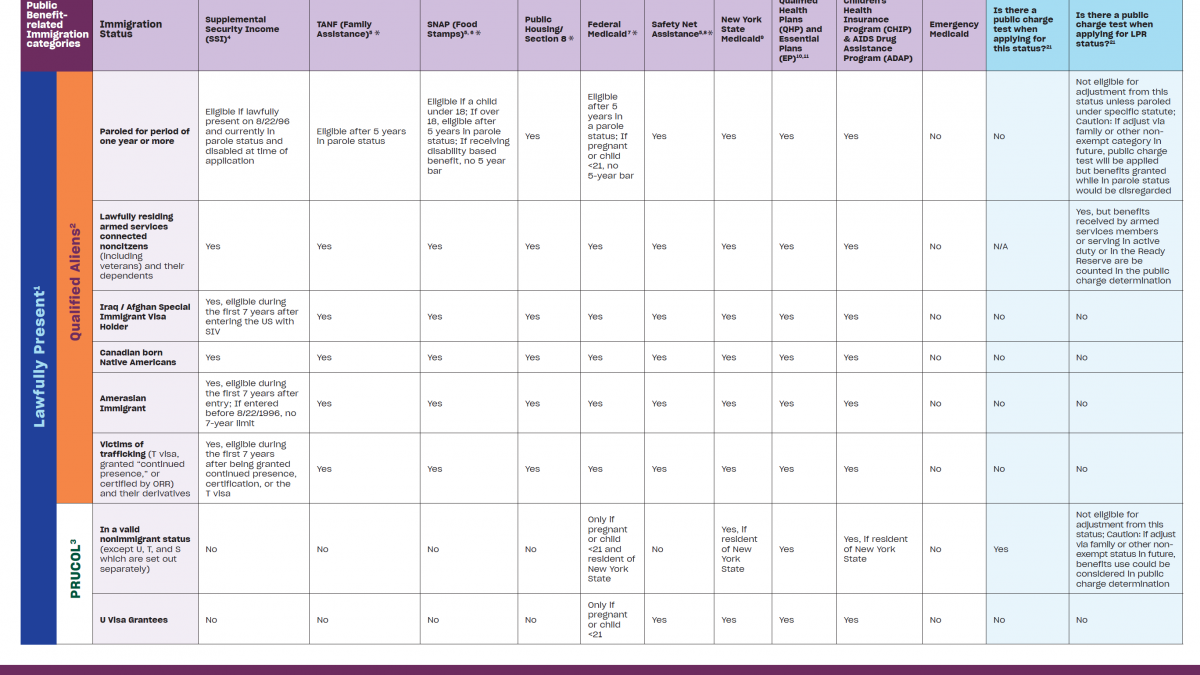
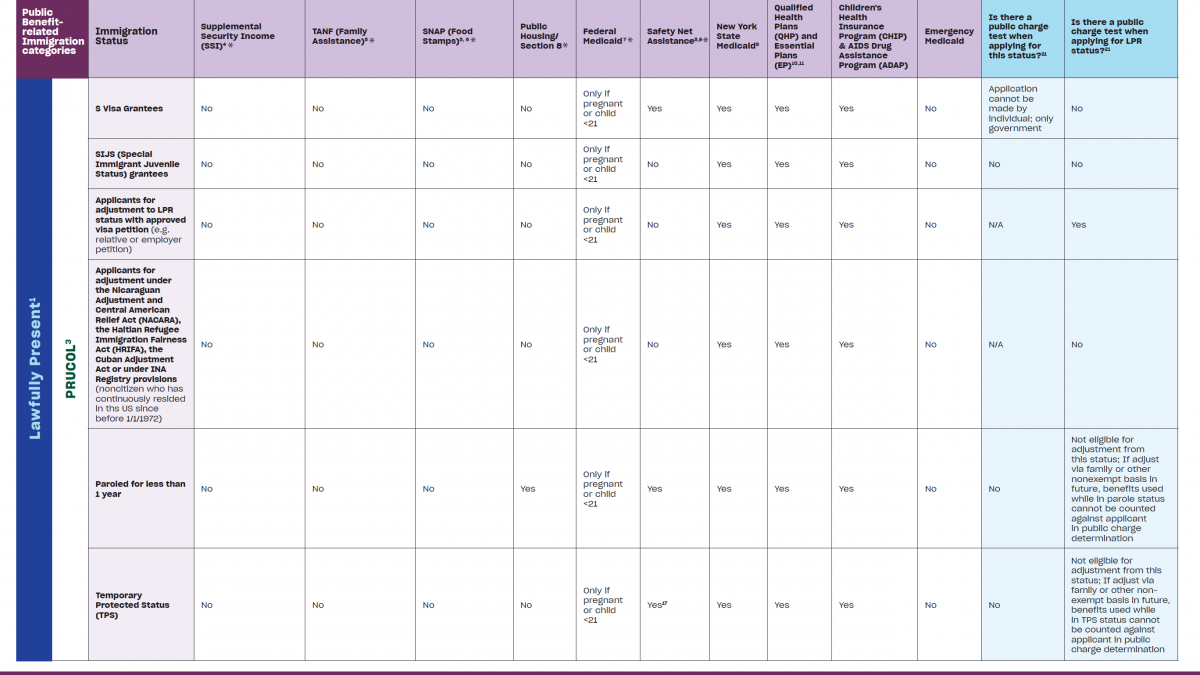
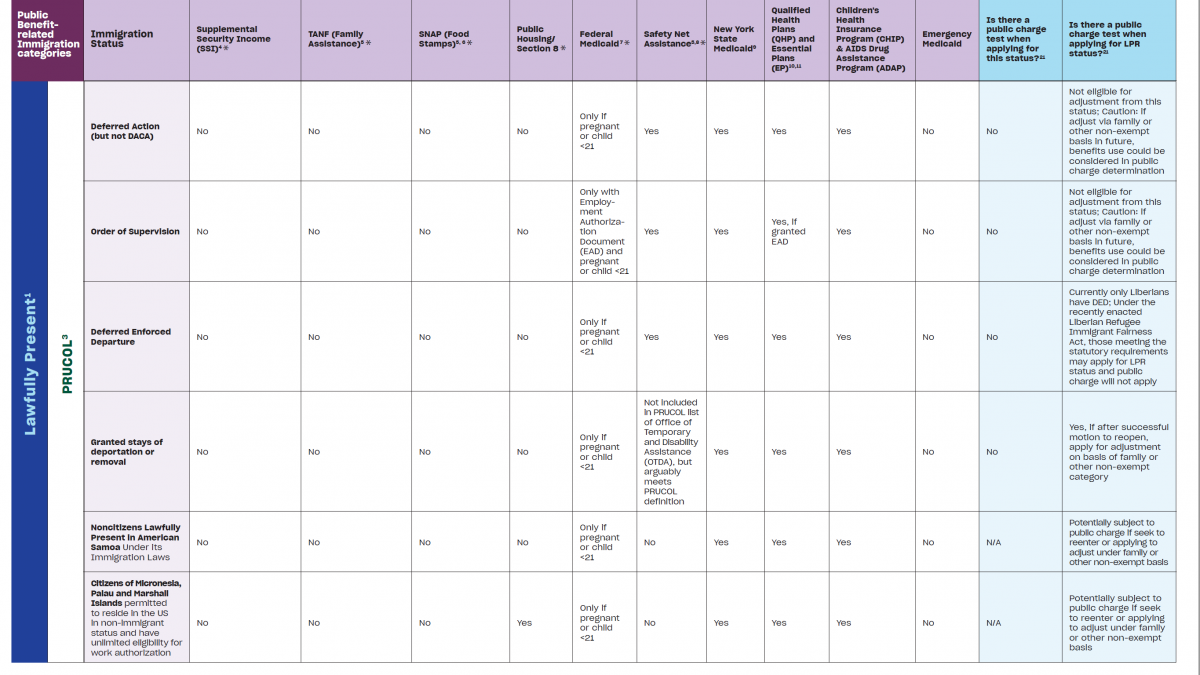
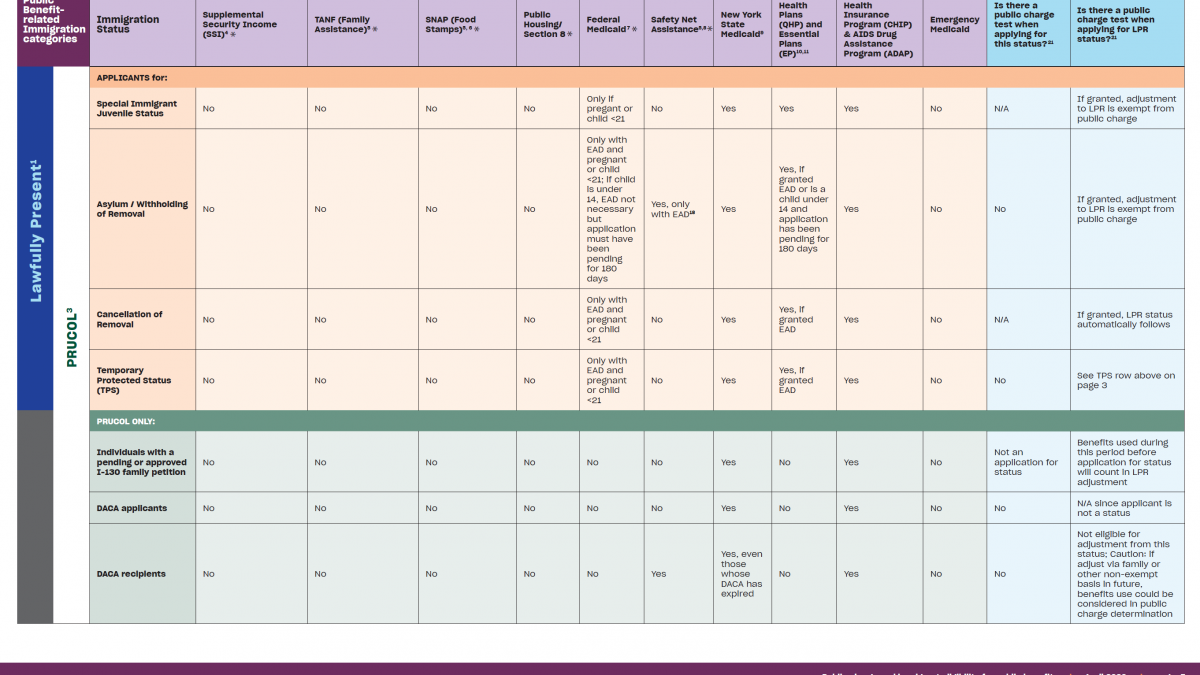
US Immigration Public Charge Chart Explaining Status and Benefits

May 6, 2020

Author: NYC Immigration Lawyer Alena Shautsova

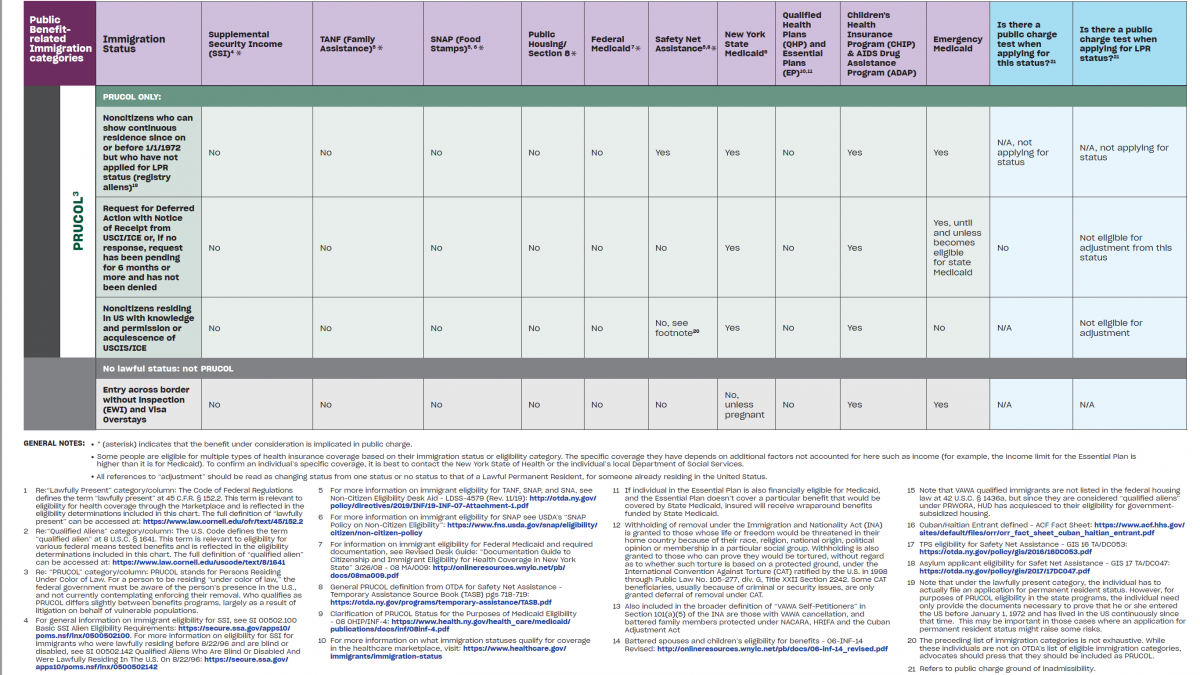
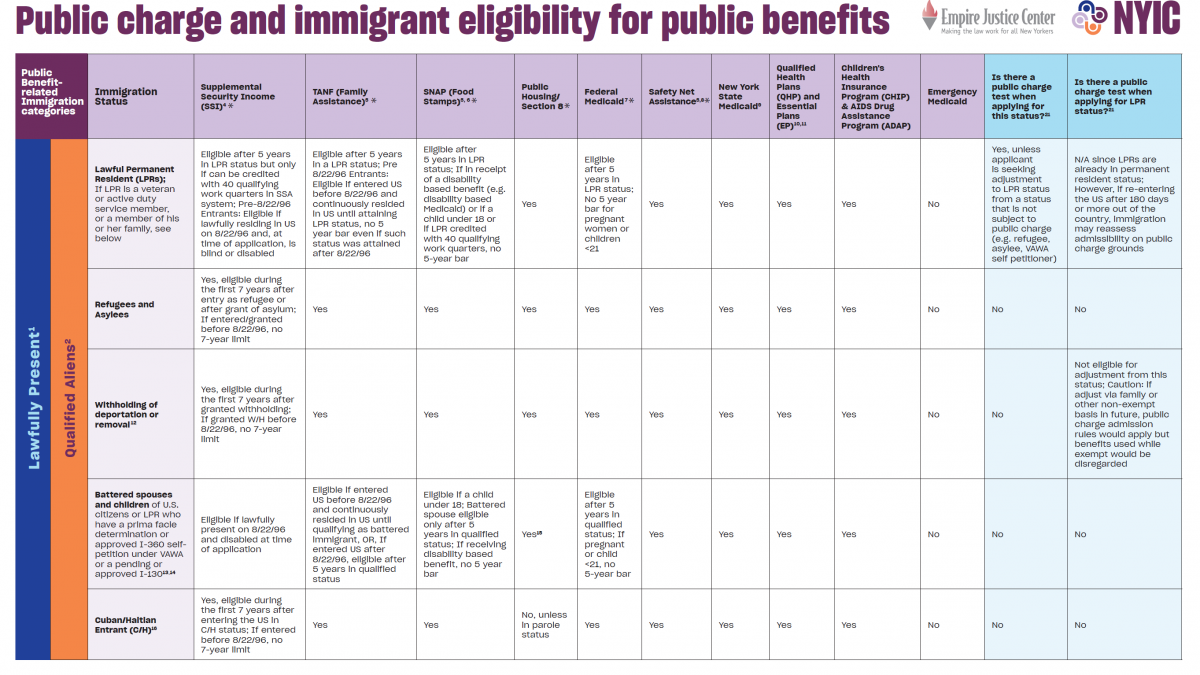
US Public Charge Rule is confusing and complex enough even for a seasoned Immigration practitioner. Public Charge test applies for certain but not all immigration filings/ benefits. For example, VAWA, asylum and refuge seekers are exempt from the public charge test, but most employment and family-based applicants are not. Also not all public benefits would count for the public charge purposes test.

Currently, the test is being used in connection with the adjustment of status filings, filings for extension and change of status and for Immigrant visa filings. Depending on the location of the applicant, the person may have to submit form I 944 (in the US) or form DS5540 (outside the US). Please note that not all the consulates are collecting DS 5540 at this time. Consulates may not even require the form to be submitted as they can ask the applicant at the interview all relevant questions. Dorm DS 5540 cannot be submitted online at this time.

Below you will find an invaluable table composed by the Empire Justice Center that explains in detail which benefits count towards public charge for which immigration filings.

Medical Hardship for Cancellation of Removal

March 31, 2020

Author: NYC Immigration lawyer Alena Shautsova

View our video on the issue:

Best New York Immigration Lawyer
NYC Immigration lawyer
https://www.youtube.com/watch?v=66EnHipb0Ew&t=30s

Establishing medical hardship for the cancellation of removal cases is one of the most important burdens of the person in removal proceedings.

Recently, the Board of Immigration Appeals issued a decision in the Matter of J-J-G, specifying a standard an applicant for cancellation of removal must meet in connection when trying to establish medical hardship to a qualifying relative. The decision specifically addresses a situation where the qualifying relative is argued to have to accompany the applicant in case of his/her removal.

Specifically, the BIA stated that the person who is trying to show that the relative will suffer exceptional and extremely unusual hardship in case of his/her removal must present evidence that the adequate medical help for the serious medical condition is not reasonably available in the country at issue.

The BIA emphasized that general evidence regarding the lesser qualify of medical care and lesser opportunities in the country at issue is insufficient to meet the requireed standard.

As such, the BIA ordered the respondent, a native of Guatemala, with five US citizen children to be removed to Guatemala! From reading the decision, it is apparent that the result was due to lack of preparation and absence of specific evidence addressing the issue of the cost and availability of the treatment for the medical condition for the qualified relative. Nevertheless, the decision will have a grave impact on thousands of the cancellation of removal applications. The text of the decision can be found here.

Coronavirus Update on US Visa Processing and International Travel

March 19, 2020

Author: New York Immigration Lawyer Alena Shautsova

If you feel that the news gets old the minute it is published, you are right! The US government just announced that it suspends US visa processing, and the US Government issued a warning against all international travel. Do not get stuck overseas!

SUSPENSION OF ROUTINE VISA SERVICES

In response to worldwide challenges related to the outbreak of COVID-19, the Department of State is suspending routine visa services in most countries worldwide.  Embassies and consulates in these countries will cancel all routine immigrant and nonimmigrant visa appointments as of March 18, 2020.  Check the website of the embassy or consulate for its current operating status.  As resources allow, embassies and consulates will continue to provide urgent and emergency visa services.

Please see: https://travel.state.gov/content/travel/en/News/visas-news/suspension-of-routine-visa-services.html

GLOBAL LEVEL 4

The Department of State advises U.S. citizens to avoid all international travel due to the global impact of COVID-19.  In countries where commercial departure options remain available, U.S. citizens who live in the United States should arrange for immediate return to the United States, unless they are prepared to remain abroad for an indefinite period.  U.S. citizens who live abroad should avoid all international travel.  Many countries are experiencing COVID-19 outbreaks and implementing travel restrictions and mandatory quarantines, closing borders, and prohibiting non-citizens from entry with little advance notice.  Airlines have cancelled many international flights and several cruise operators have suspended operations or cancelled trips.  If you choose to travel internationally, your travel plans may be severely disrupted, and you may be forced to remain outside of the United States for an indefinite timeframe.

Please see: https://travel.state.gov/content/travel/en/traveladvisories/ea/travel-advisory-alert-global-level-4-health-advisory-issue.html

No Cancellation if Asylum Filing Was Frivolous Says BIA

May 31, 2019

No Cancellation if Asylum Filing Was Frivolous Says BIA

Author: Deportation Lawyer Alena Shautsova

There exists a wrong practice among Immigration law practitioners (fraudsters) to file an asylum claim on behalf of an individual with the purpose of filing for cancellation of removal later in Immigration court. What happens is that people essentially get “tricked” by these practitioners into believing that they can get away with filing a frivolous asylum case and later, when they transferred to court, they will be able to successfully file for a relief with the judge in a different form. At times, people are not even aware they filed for asylum!

Here is a first point: a person has to file for asylum within a year of his/her entry into the US. If you spent here 10 years and more (one of the qualifications for cancellation of removal), chances are you will NOT qualify for asylum unless certain, very narrow exceptions are met.

Second, an asylum application must have merit: you cannot allege that you are afraid of criminal situation in your country general. This is NOT a basis for asylum. It takes months to prepare an asylum application and thoroughly collect all the evidence; if the evidence is not available you must explain why. 

There is a punishment under the law for those who submit  frivolous or fraudulent asylum applications. 

So, within the past years, there were numerous reports of filing for asylum in order to get a cancellation of removal relief: an application for a green card available to be filed in court only. Now, the BIA held that this practice will be sufficiently abolished: if the Immigration judge determines that the asylum application was filed just so that the person could file for cancellation of removal, the proceedings will be DISMISSED! It means that the person will not have a chance to file for cancellation of removal.  See Matter of ANDRADE JASO and CARBAJAL AYALA, 27 I&N Dec. 557 (BIA 2019). 

If one desires to place himself/herself in removal proceedings, even generally not recommended to do so, he/she should request that the government issue a Notice to Appear rather than submit a frivolous asylum case. This approach might come with less success, but will save time, money, and potentially safeguard from civil and criminal penalties.