Asylum in USA, Immigration To The USA

Delivering Solutions For Your Future
Immigration in America, USA flag

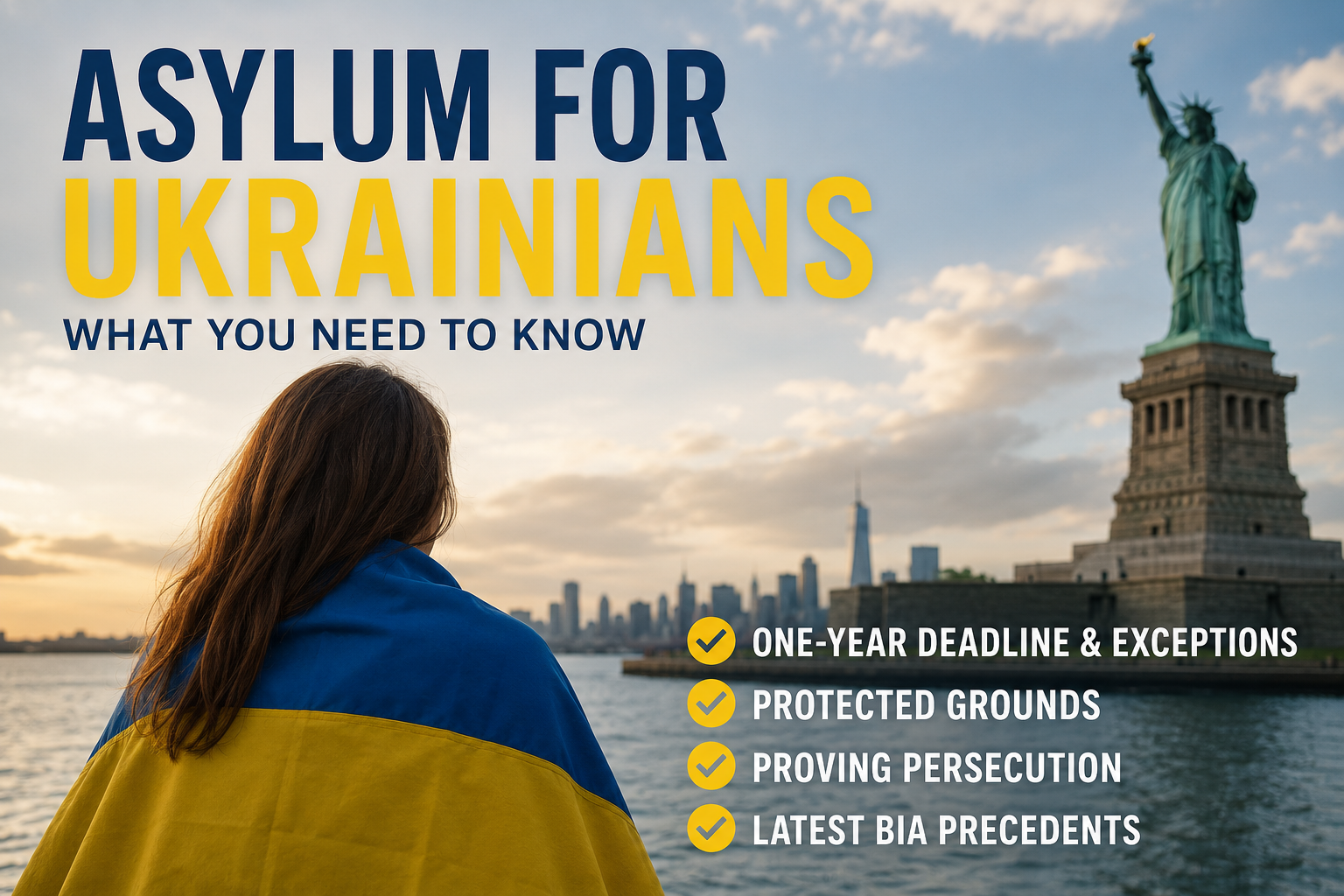
Asylum for Ukrainians in the United States: What You Need to Know in 2026

July 11, 2026

Asylum for Ukrainians in the United States: What You Need to Know in 2026

By Alena Shautsova, New York Immigration Lawyer

Asylum For Ukrainians

The war in Ukraine has forced millions of people to flee their homes. Many Ukrainians came to the United States through Uniting for Ukraine (U4U), while others entered with visas, parole, or later obtained Temporary Protected Status (TPS).

One of the most common questions I receive is:

“Can I still apply for asylum?”

The answer is yes—but it is much more complicated than simply proving that there is a war in Ukraine.

Asylum law has become increasingly technical. Recent decisions by the Board of Immigration Appeals (BIA) have made it even more important to prepare an asylum application carefully from the very beginning. A successful asylum case today requires a strategic legal analysis of filing deadlines, protected grounds, credibility, and evidence.

If you are considering filing for asylum, this article explains the three major issues that every Ukrainian applicant should understand.


Step One: The One-Year Filing Deadline

One of the biggest obstacles in many Ukrainian asylum cases is the one-year filing deadline.

Generally, U.S. immigration law requires that an asylum application be filed within one year of the applicant’s last arrival into the United States. INA §208(a)(2)(B). However, Congress also recognized that some applicants have legitimate reasons for filing later. The law therefore allows exceptions for changed circumstances and extraordinary circumstances, provided the application is filed within a reasonable period after those circumstances arise.

Many Ukrainians understandably delayed filing because they were lawfully present in the United States through other humanitarian programs.

Examples include:

  • Uniting for Ukraine (U4U) parole
  • Temporary Protected Status (TPS)
  • Student status
  • Employment visas
  • Other lawful immigration status

Maintaining lawful status or another authorized form of stay may, depending on the facts of the case, support an argument that the applicant qualifies for an exception to the one-year filing deadline. Whether such an exception applies depends on the individual circumstances and should be evaluated carefully.

Can TPS Help?

For many Ukrainians, TPS has provided temporary protection from removal and work authorization.

However, TPS is not permanent immigration status.

If TPS eventually ends or circumstances change, that change may become legally significant for asylum purposes. Likewise, maintaining TPS or U4U parole may help explain why an individual did not immediately seek asylum after arrival, depending on the specific facts of the case.

Every situation is different. There is no automatic rule that TPS or U4U excuses a late filing, but these programs frequently become an important part of the legal analysis.

This is one of the first issues an experienced asylum lawyer should evaluate before preparing the asylum application.


Step Two: You Must Prove Persecution on a Protected Ground

Many people mistakenly believe that being from a country experiencing war automatically qualifies them for asylum.

Unfortunately, that is not how U.S. asylum law works.

To qualify for asylum, the applicant must prove persecution or a well-founded fear of persecution because of one of five protected grounds:

  • Political opinion
  • Religion
  • Nationality
  • Race
  • Membership in a particular social group

The persecution must occur because of one or more of these protected grounds—not simply because of generalized violence or armed conflict.


Political Opinion

Political opinion remains one of the strongest grounds in many Ukrainian asylum cases.

Examples may include:

  • Opposition to Russian occupation
  • Public criticism of Russian authorities
  • Support for Ukrainian independence
  • Participation in political demonstrations
  • Volunteer work supporting the Ukrainian military
  • Collection of humanitarian aid
  • Public social media activity

Political opinion cases often require extensive documentation showing:

  • what the applicant believed,
  • what the persecutors believed,
  • why they targeted the applicant.

Imputed Political Opinion

Sometimes the applicant never publicly expressed political views.

That does not necessarily defeat the asylum claim.

The persecutor may simply believe that the applicant supports Ukraine, opposes Russia, or belongs to a political movement.

This is called imputed political opinion, and it is recognized under U.S. asylum law.

For example:

  • relatives of Ukrainian soldiers,
  • family members of local officials,
  • journalists,
  • volunteers,
  • individuals living in occupied territories,

may be viewed by persecutors as political opponents even if they never considered themselves politically active.

The persecutor’s perception is often just as important as the applicant’s own beliefs.


Religion

Religion can also serve as the basis for asylum.

Examples may include persecution because of:

  • religious affiliation,
  • participation in certain churches,
  • refusal to abandon religious beliefs,
  • discrimination in occupied territories because of faith.

Again, the key question is not whether discrimination exists generally, but whether this applicant was targeted because of religion.


Membership in a Particular Social Group

Another possible basis involves membership in a particular social group (PSG).

Developing a legally viable PSG requires careful legal analysis.

The proposed group must satisfy the legal requirements developed through decades of asylum case law.

Examples may include carefully defined family-based groups or other narrowly tailored social groups, depending on the individual facts. Simply belonging to a broad category of people affected by the war is usually not enough.


Every Ukrainian Case Is Different

No two asylum cases are identical.

One person may qualify because of political opinion.

Another because of religion.

Another because persecutors falsely believed the person supported the Ukrainian government.

Another because of membership in a legally recognized social group.

The legal theory should always be built around the applicant’s actual experiences—not around a generic description of conditions in Ukraine.


Step Three: Proving Past Persecution Has Become Increasingly Important

Recent Board of Immigration Appeals decisions continue to emphasize that asylum applicants must present detailed, credible, and legally sufficient evidence establishing that the harm they suffered rises to the level of persecution and that there is a nexus between that harm and a protected ground.

Many applicants assume that telling their story is enough.

Unfortunately, today’s asylum practice requires much more.

You should be prepared to provide evidence such as:

  • medical records,
  • police reports,
  • photographs,
  • witness statements,
  • military records,
  • news articles,
  • social media evidence,
  • psychological evaluations,
  • country condition reports,
  • expert opinions where appropriate.

The stronger the documentation, the stronger the asylum case becomes.


Small Details Can Win—or Lose—an Asylum Case

Immigration Judges frequently evaluate:

  • consistency between interviews,
  • written declaration,
  • supporting evidence,
  • testimony,
  • prior immigration filings.

Small inconsistencies can become significant if they affect important facts.

That is why preparing testimony carefully is essential.


Matter of M-A-F-: Be Careful When Updating Your Asylum Application

Another important case every asylum applicant should understand is Matter of M-A-F-, 26 I&N Dec. 651 (BIA 2015).

Many people assume they can simply “update” an asylum application whenever new events happen.

Sometimes they can.

Sometimes they cannot.

Matter of M-A-F- explains that an amended asylum application may actually be treated as an entirely new asylum application if it presents a new basis for relief or relies on substantially different facts. When that happens, the filing date of the later application can control for purposes of the one-year filing deadline and other legal issues. By contrast, amendments that merely clarify or modestly supplement the original claim generally remain amendments rather than new applications.

This distinction has become increasingly important in recent litigation involving motions to pretermit asylum applications based on timeliness.

For Ukrainians, this means that if significant events occur after the initial filing, you should not simply prepare a new declaration without understanding the legal consequences.

The strategy must be planned carefully.


Practical Tips for Ukrainians Considering Asylum

Do not wait until your immigration status expires.

Waiting often creates unnecessary legal complications.


Preserve evidence.

Save:

  • photographs,
  • text messages,
  • emails,
  • Telegram conversations,
  • Facebook posts,
  • videos,
  • military documents,
  • medical records,
  • proof of volunteer activities.

You may need them years later.


Tell the complete story.

Many applicants leave out important events because they think they are unimportant.

Sometimes those overlooked facts become the strongest part of the case.


Think about protected grounds first.

The strongest asylum applications are organized around the legal requirements—not simply around a chronological story.


Be consistent.

Every document submitted to USCIS or Immigration Court should accurately reflect your history.

Consistency builds credibility.


Work with an experienced asylum lawyer.

Modern asylum law changes constantly.

Recent BIA precedent decisions continue to reshape issues involving filing deadlines, credibility, nexus, and proof of persecution. A well-prepared legal strategy can make a significant difference in the outcome of your case.


Final Thoughts

Ukrainians continue to face unique immigration challenges.

Some remain protected through TPS.

Others entered through Uniting for Ukraine.

Many are now wondering what comes next.

Asylum may be available—but success depends on much more than showing that Ukraine remains dangerous.

Your attorney must carefully analyze:

  • whether the one-year filing deadline can be overcome,
  • which protected ground best fits your case,
  • how to prove past persecution,
  • whether the evidence is sufficient,
  • how recent BIA precedent affects your application,
  • whether any amendments to the asylum application could trigger issues under Matter of M-A-F-.

Every asylum case deserves an individualized legal strategy.

Contact an Experienced New York Asylum Lawyer

If you are a Ukrainian national considering asylum in the United States, do not assume that your case is either automatically strong or automatically impossible. The right legal strategy often begins with a careful review of your immigration history, your evidence, and the most recent developments in asylum law.

At the Law Office of Alena Shautsova, I personally evaluate each case, identify potential one-year filing deadline issues, analyze the strongest protected grounds, and prepare asylum applications designed to withstand close scrutiny under today’s legal standards.

If you would like experienced guidance with your asylum case, contact my office today to schedule a consultation. Together, we can evaluate your options and develop the strongest possible strategy to protect your future in the United States. CALL 917 885 2261.